


All Sights
The sights, landmarks, points of interest, entertainment and dining on the Costa Brava. Filter by type and location to quickly find places to visit on the Costa Brava coast.

The beautiful residence on top of the Cap Sa Sal cape in Begur is a former hotel, for the longest time one of the leading competitors of Hostal La Gavina in S’Agaro to host celebrities visiting the Costa Brava coast. The hotel was opened on July 4, 1963, after a prolonged construction period that lasted eight years, and closed down at the end of the 1970s when it became clear that its average annual revenue was too low to maintain the luxurious presentation of the premises.
Today, the building has multiple owners that rent out their expensive apartments either directly or with the help of management companies. The facade of the building doesn’t betray this fact and eagerly attracts the gaze of onlookers observing the coast from the Begur township of Sa Tuna.
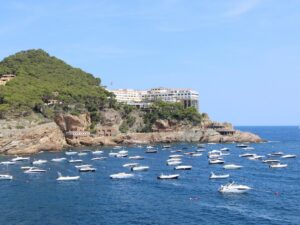
Cape Sa Sal
41.9659990000, 3.2317100000
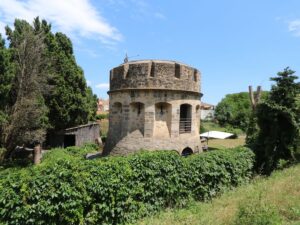
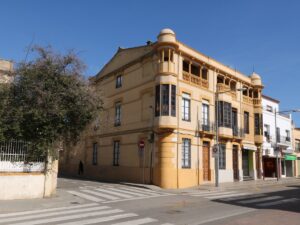
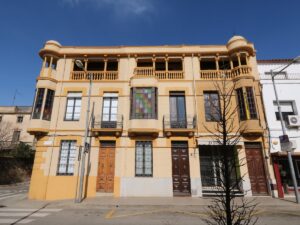
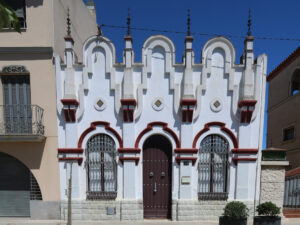
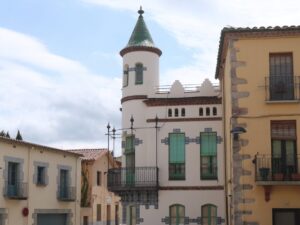
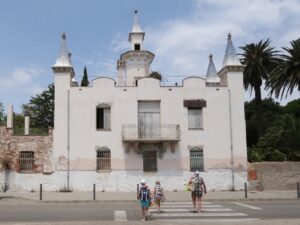
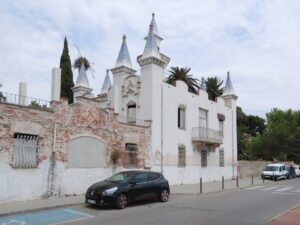
Casa Estrada, known colloquially as Xalet de les Punxes (“House of Spikes”), is one of the most conspicuous mansions lining up the promenade along Sant Pol beach. Unlike its neighbours, it boldly faces the street, not hiding behind garden greenery, and thus can be easily seen from any point on the beach. Its nine turrets—eight along the perimeter and one in the centre—inevitably attract the gaze and attention of the passersby who also can’t help but notice the unkempt and shoddy appearance of the house as a whole.
Until 1890, when the construction of Casa Estrada began, this spot had been occupied by barracks where Pere Màrtir Estrada Cama (1841-1911), the local industrialist made wealthy by cork production, stored his boat and tools. Building the mansion took over 20 years and finished in 1912, after its commissioner’s death.
Local historians have always wondered whether there was any connection between the nine turrets of the estate and the nine children of the owner, born between 1871 and 1883. The rumour goes that Pere Estrada dedicated each of the turrets to each one of his children but ostensibly some neighbours may have heard that the father himself denied it…
The Estrada family line is well-respected in Sant Feliu de Guíxols, whose history can be traced back to the 18th century. After Casa Estrada, in the short period between 1910 and 1915, the family managed to erect four more mansions on the boulevard Passeig de Sant Pol.
Casa Estrada was built in the heyday of the Catalan modernisme and its influence is easy to spot in the usage of the trencadís mosaic technique and decorations using nature motifs and ornaments.
In 2006, the structure received a spot on the list of cultural heritage objects of local interest. This status implies that the owner follows specific norms to maintain the appearance of the historic object.
In 2013, the municipality of Sant Feliu de Guíxols allowed the usage of mansions along Passeig de Sant Pol as tourist accommodation. The hustle and bustle around Casa Estrada was almost instant—its new owner conceived an idea of opening a luxurious hotel here.
However, the construction came to a halt barely a year after it started. Ever since then the locals and the visitors of Sant Feliu de Guíxols may witness the sorry state of the historic mansion that sits unoccupied and uncared for. At the same time, its shabby appearance is in no way threatening to the passersby so the municipality can’t do much to compel the owners to keep it neater.
Casa Estrada (Tower of Spikes)
41.7890240000, 3.0455790000
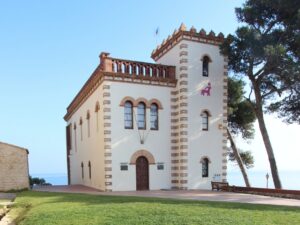
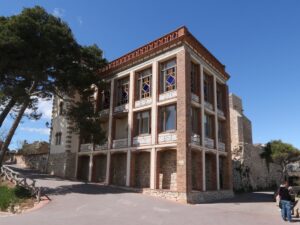
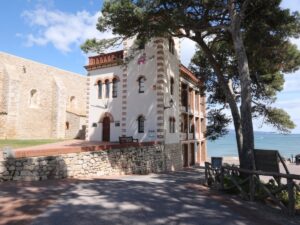
The estate Casa Forestal in Sant Martí d’Empúries is a three-storey house standing at the edge of the village, built in 1910 to house the technical staff of Servei Hidrològic i Forestal, a government agency overseeing the protection and development of water and forest resources.
Casa Forestal combines elements of Art Nouveau on its front facade and Art Deco on the side and back. It is the work of L’Escala architect Miquel Torres i Brugés, owned at the time by one of the engineers from Servei Hidrològic i Forestal, Josep Reig i Palau, whose initials can be seen in the ornaments decorating the back gallery.
Today, the construction of this or any other building in this specific spot, in Sant Martí d’Empúries, would be impossible as this is where precious evidence of ancient life is found underground. The Forestal estate, for example, stands atop the ruins of a fortification wall of a Greco-Roman settlement.
Casa Forestal
42.1398260000, 3.1185730000
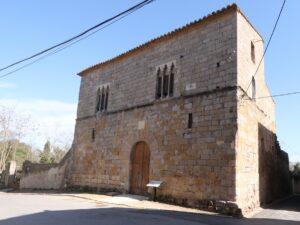
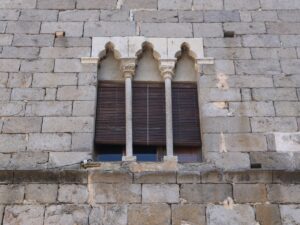
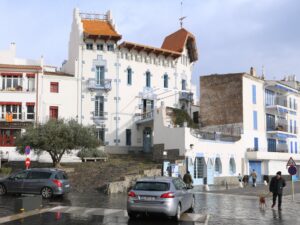
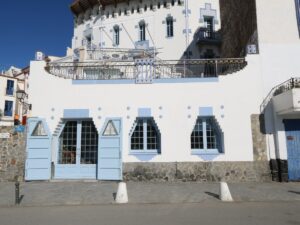
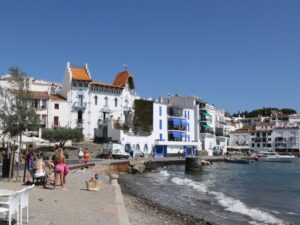
Casa Serinyana, also known as “The Blue House” (Casa Blaua), is an Art Nouveau house built in Cadaqués at the beginning of the 20th century by the architect Salvador Sellés for the wealthy Serinyana family.
The Serinyana house has three floors and an attic. A unique feature of the house is the connection of the main building to a small warehouse located on the other side of the alleyway by the town quay. To unite these two very different buildings, the architect put a terrace on top of the storage unit and connected it to the second floor of the living quarters by throwing a small bridge over the alleyway.
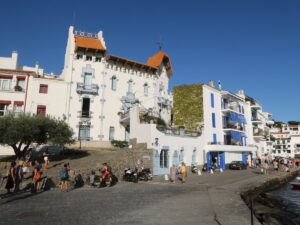
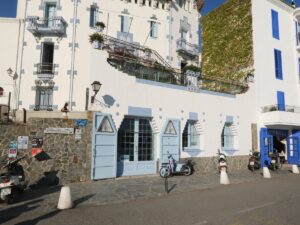
Casa Serinyana Mansion
42.2890020000, 3.2797410000
The house for Francesc Vilahur Forners was built in 1917 by the Girona architect Isidre Bosch i Batallé. In the 1950s and 1960s, the original structure was rebuilt slightly—the portico columns were doubled, while the entrance staircase was moved into the garden.
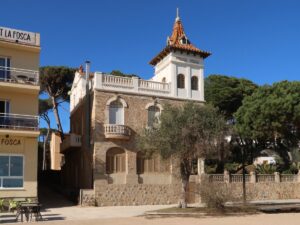
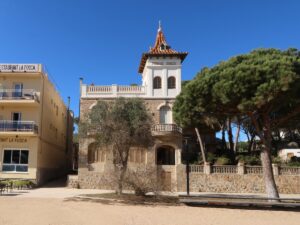
Casa Vilahur Mansion
41.8577200000, 3.1428060000