


Cemeteries

The cemetery of Roses is included on the list of the cultural heritage sights of Catalonia thanks to the monument on the family crypt of the local politician and lawyer Pere Rahola i Molinas. The work was completed by the outstanding Art Nouveau sculptor Josep Llimona i Bruguera.
The inscription FAMILIA PERE RAHOLA RIP on the gravestone requires an explanation. When Josep Llimona was working on the sculpture, its subject was alive and well and, as it happens, outlived the artist by 22 years. The inscription was chosen in advance and simply referenced the most outstanding member of that family.
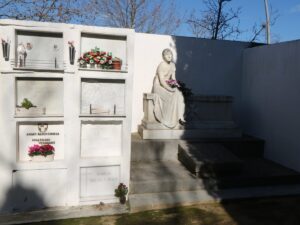
Cemetery of Roses
42.2682950000, 3.1818650000
The cemetery of Sant Feliu de Guíxols is on the list of the cultural heritage objects of Spain thanks to the works of renowned Catalan architects and sculptors displayed there. For instance, the crypt of the Casas family was designed by the outstanding Art Nouveau architect Josep Puig i Cadafalch. The sculptures on the crypt of the Sibils family were completed by Rafael Atché who authored the statue crowning the monument to Columbus in Barcelona. Last but not least, Josep Campeny i Santamaria who designed the angel for the graves of the Vilaret family also built three memorable fountains in the Barcelona’s Eixample: Font de la Granota (Carrer de Còrsega – Avinguda Diagonal), Font del Noi dels cantirs (Plaça Urquinaona) and Font del Trinxa (Ronda Universitat – Carrer del Pelai).
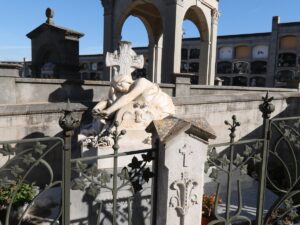
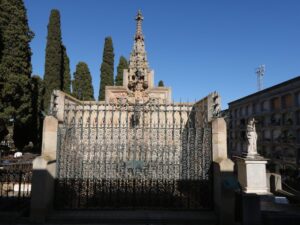
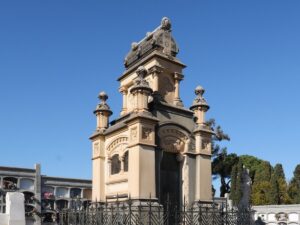
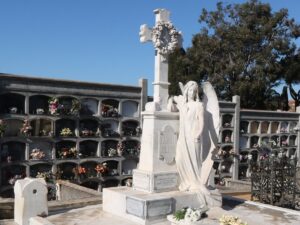
Cemetery of Sant Feliu de Guíxols
41.7802170000, 3.0197650000
The cemetery next to the historic centre of L’Escala appeared in town in 1835. It’s referred to as a “marine” cemetery, mostly receiving people whose lives were tied with the sea in one way or another—fishermen and workers of the sardine and anchovy salting factories in the area.
The cemetery is small: a small courtyard at the entrance, a chapel, four pantheons and a few hundred niches for urns, all painted in dazzling white.
In 1970, the cemetery became disused, and in 1974, it was named a historical monument. Here rests a local celebrity, famous Catalan writer Caterina Albert who published her works under the pseudonym Víctor Català.
The cemetery is closed to the public. Visiting it is possible if you are able to obtain the keys in the nearby police station—for that, you would evidently need to prove some sort of familiar connection with a deceased L’Escala resident. The walls of the cemetery are not too tall though and you wouldn’t have trouble finding a good angle to snap some photos.
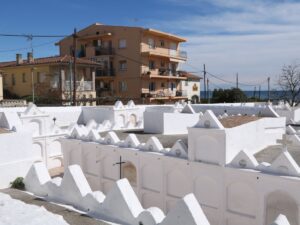
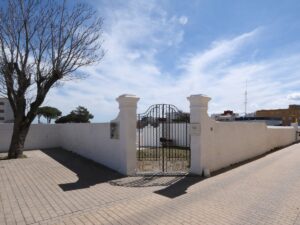
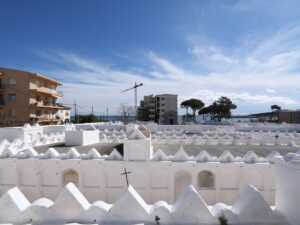
Marine Cemetery
42.1219210000, 3.1362140000
Starting almost any building project in Catalonia at the end of the 19th and the beginning of the 20th century guaranteed predictable, eye-pleasing results: Art Nouveau had taken the region by storm and started resembling an epidemic during that era. For the art lovers today, who are enthralled by the architectural style, this is a blessing and a curse: not only do we visit museums, theatres and lush houses of the bourgeoisie, but also explore former hospitals1, slaughterhouses2, tuberculosis dispensaries3 and even active cemeteries to get our fix.
The restoration works at the cemetery of Lloret de Mar took place in the heyday of Catalan Art Nouveau (the renovated cemetery was inaugurated on November 2, 1901) and coincided with the return home of yet another group of indianos (Spanish nationals who left Europe to make fortunes in Latin America and to return home extremely wealthy). Once all the splendid villas that were clearly necessary for the enjoyment of life were built, the indianos rolled up their expensive sleeves to prepare for comforts in the life after next, commissioning numerous family crypts, mausoleums, and monuments from the renowned architects and sculptors of the time.
And so, in Lloret de Mar, the place of eternal rest and remembrance turned into a tourist attraction. Today, each grave in the central part of the cemetery is marked with an information plaque that indicates the monument’s creator, the date it was built, the techniques used and any possible inspirations. Many monuments feature a photograph of the master that many visitors take for the portrait of the deceased. This is the case with Bonaventura Conill who contributed several works to the Lloret de Mar cemetery. After encountering his photo numerous times, one may inadvertently wonder just how many times he managed to die!
If you need a bit more convincing to visit a cemetery as part of your annual vacation, consider the names of Antoni Gallissà4, Eusebi Arnau5 and the great Josep Puig i Cadafalch. They all contributed to the unique Modernist cemetery in Lloret de Mar.
The cemetery is open to visitors from 8 am to 6 pm from November to March, and to 8 pm from April to October. The entrance is found at the intersection of Carrer de Plató and Avinguda Vila de Blanes.
1)Hospital San Pau (officially known as El Hospital de la Santa Creu i Sant Pau) is a grandiose project of the Catalan Art Nouveau architect Lluís Domènech i Montaner.
2)Escorxador, “slaughterhouse”, is the project of Pere Caselles located in Reus, at Carrer Escorxador, s/n.
3)Dispensari Antituberculós, “anti-tuberculosis dispensary”, was built by Joan Rubió i Bellver, a pupil of Antoni Gaudí, in Reus, at Carrer Sant Joan, 38.
4)Antoni Maria Gallissà i Soqué is a Catalan Art Nouveau architect and a professor of the Barcelona School of Architecture who was famous not only for his standalone work in Barcelona and its environs, but also for participation in the projects of Lluís Domènech i Montaner, Josep Jujol, Elies Rogent and other notable masters.
5)Eusebi Arnau i Mascort is a famous Catalan Art Nouveau sculptor who collaborated with Lluís Domènech i Montaner, Josep Puig i Cadafalch, and Enric Sagnier. The works of Arnau are present, in particular, on Barcelona’s Passeig de Gràcia (Casa Lleó i Morera and Casa Amatller), in the Hospital San Pau, at the Palau de la Música Catalana and in the Temple Expiatori del Sagrat Cor cathedral on the Tibidabo mountain.
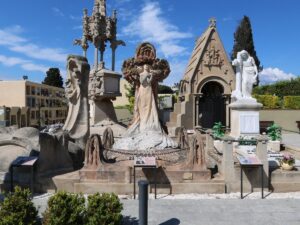
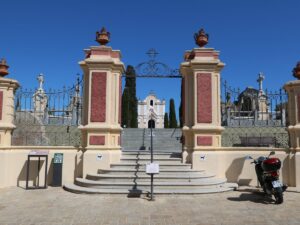
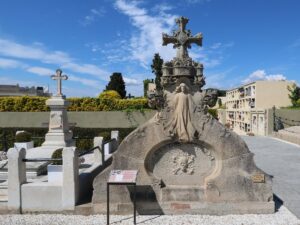
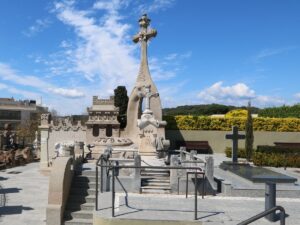
Modernist Cemetery in Lloret de Mar
41.7015510000, 2.8361730000
The cemetery of Cadaqués is notable for the gravesite of the economist and politician Frederic Rahola and his wife Caritat Serinyana. The site is decorated by the work of the sculptor Josep Llimona i Bruguera, one of the most memorable artists representing Catalan Art Nouveau.
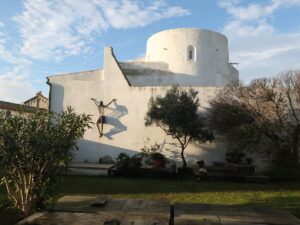
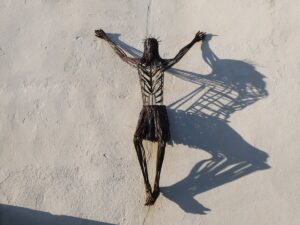
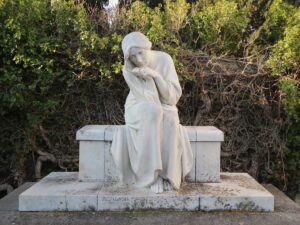
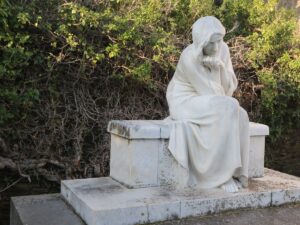
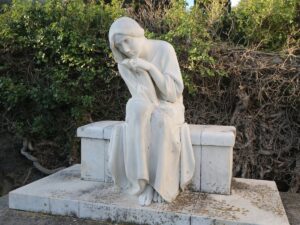
The Cemetery of Cadaqués
42.2918940000, 3.2842390000