

Sights of L'Escala

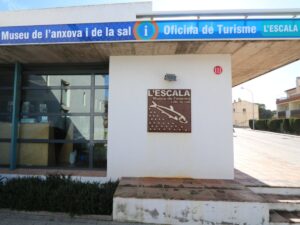
L’Escala is one of the few resorts on the Costa Brava renowned not only for its idyllic beaches and remarkable Roman ruins but also for its delicious food: “anchovies from L’Escala” is a signature regional offering akin to “wine from Priorat”, “prawns from Palamós” and “chickens from Empordà”. No wonder then that the Anchovy and Salt Museum (Museu de l’Anxova i de la Sal) — the only museum in town — is dedicated to fishing and the art of salting and pickling.
The first fishing harbour was built here back in the 16th century to service the needs of fishermen from nearby towns. In 1680, the first stone of a church foundation was laid here, thus giving the small settlement town status. Active fishing and bustling trade helped L’Escala to grow fast — over the course of the 18th century, the town quadrupled in size and became a desirable destination for folk looking for fishing work: many peasants from surrounding regions would abandon their lands, gardens and farms to move to L’Escala and join the ranks of local fishermen.
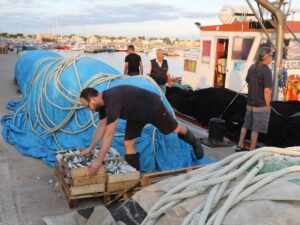
Until the 1960s, every adult resident of L’Escala either sailed out to sea every morning or salted anchovies and sardines at one of the specialized local factories. Spain was hit with a tourism boom in the sixties, causing the younger generation to reconsider the town-wide business model — many got to work in hospitality instead. Today, the fishing fleet at L’Escala consists of just over fifty fishing boats. The salting factory count is eight; all of them have moved outside the town border so as not to impede the flood of beach vacationers descending on the Costa Brava every summer.
The brand ANCHOA DE L’ESCALA is officially recognized with INDICACIÓN GEOGRÁFICA PROTEGIDA, a system of certificates that are used in Spain to distinguish products of the highest quality with known origins. In the case of L’Escala anchovies, this seal of approval also signals the absence of artificial flavours or preservatives in the tin — the anchovies are salted according to the traditional recipes and techniques.
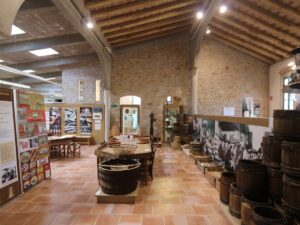
Visiting the Anchovy and Salt Museum in the Costa Brava would be immensely pleasing to fishing fans and amateur chefs alike. For the former, the museum has an exhibit on fishing techniques, netting and bait, as well as the history of local fishing and the evolution of the fishing trade as a whole. For the latter, traditional salting and pickling recipes are documented, with all the necessary “equipment” — salt, water, paper, wooden and clay containers — readily on display.
Visitor information
Address: Avinguda Francesc Macià, 1 | L’Escala
Phone: +34 972 776 815
E-mail: museu@lescala.cat
Visitor hours:
01.07-31.08: 10:00 am — 1:00 pm (daily), 5:00 — 8:00 pm (Monday to Saturday)
01.09-30.06: 10:00 am — 1:00 pm (Tuesday to Saturday and holiday Mondays)
The museum is closed December 25-26 and January 1 and 6.
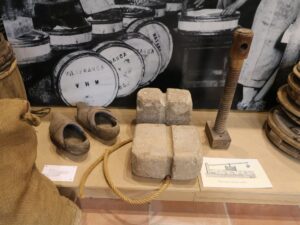

Anchovy and Salt Museum
42.1257170000, 3.1261090000
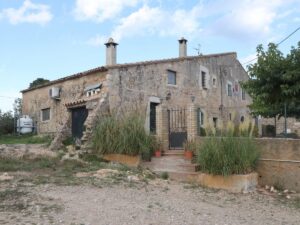
Can Cinto Xuà is a fisherman’s hut typical of an 18th-19th-century Costa Brava pueblo. Previously modest fishing villages have since become fashionable resort towns so the interiors of the huts have changed as well — modern design, expensive furniture, and decorative art have replaced fishers’ humble belongings.
To preserve the memories of times long past, the interior of Can Cinto Xuà replicates the traditional dwelling that was common among fishermen of L’Escala, with simple furniture, fishing tools and supplies, cookware and everyday items.
Can Cinto Xuà visits are organized by the Anchovy and Salt Museum. You may leave your phone number at the museum, and when there is enough interest for a group visit, you will be invited to attend a guided tour of Can Cinto Xuà.
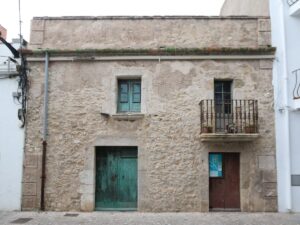
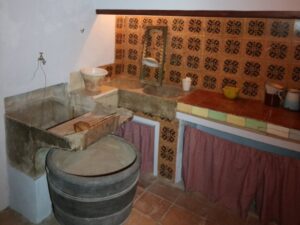
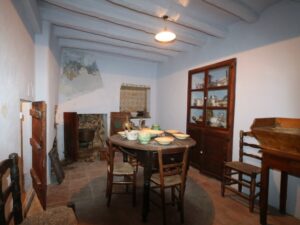
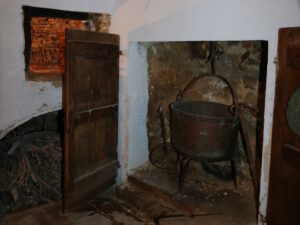
Can Cinto Xuà Fisherman's House
42.1259490000, 3.1345330000
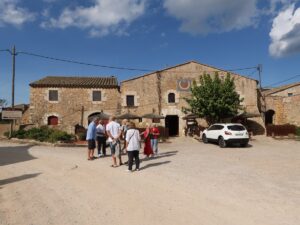
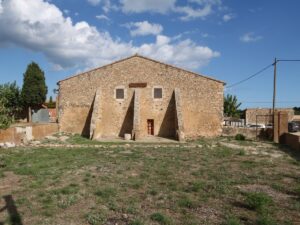
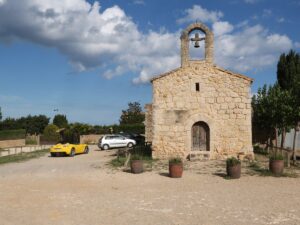

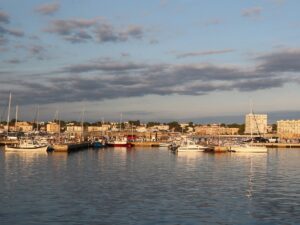
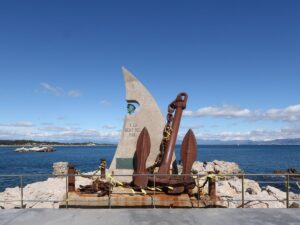
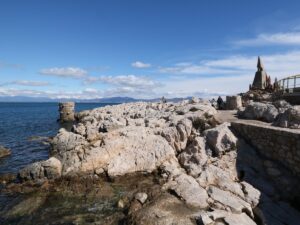
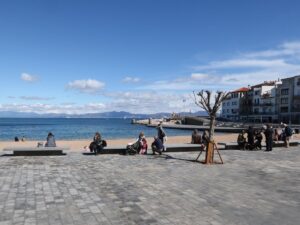
The word punta, among other things, means an endpoint of something both in Catalan and Spanish. In the Costa Brava, whose coastline contains hundreds of coves and cliffs, this may refer to a good thousand places yet add a definitive article to the word and la punta becomes something unique and universally recognizable. In L’Escala, the spot that deserves such designation is the cape hugging the central city beach Platja de les Barques on the west side.
An evenly paved area between the coastal line and the town streets is a usual spot for concerts and performance shows, especially during the Mediterranean music and art festival PortalBlau.
In 1979, the monument A la Gent del Mar was erected on La Punta, created by a L’Escala native, sculptor Josep Simón.
La Punta
42.1277540000, 3.1339170000
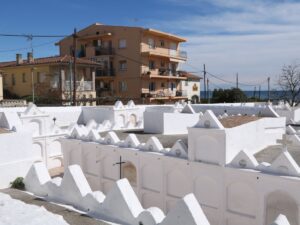
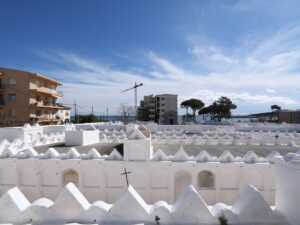
The cemetery next to the historic centre of L’Escala appeared in town in 1835. It’s referred to as a “marine” cemetery, mostly receiving people whose lives were tied with the sea in one way or another—fishermen and workers of the sardine and anchovy salting factories in the area.
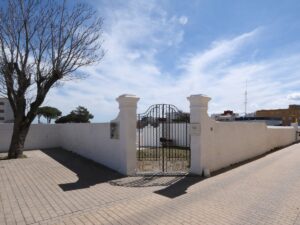
The cemetery is small: a small courtyard at the entrance, a chapel, four pantheons and a few hundred niches for urns, all painted in dazzling white.
In 1970, the cemetery became disused, and in 1974, it was named a historical monument. Here rests a local celebrity, famous Catalan writer Caterina Albert who published her works under the pseudonym Víctor Català.
The cemetery is closed to the public. Visiting it is possible if you are able to obtain the keys in the nearby police station—for that, you would evidently need to prove some sort of familiar connection with a deceased L’Escala resident. The walls of the cemetery are not too tall though and you wouldn’t have trouble finding a good angle to snap some photos.
Marine Cemetery
42.1219210000, 3.1362140000
Phone: 972 772 368, 606 585 670, 636 793 278
www.masperaquintana.com
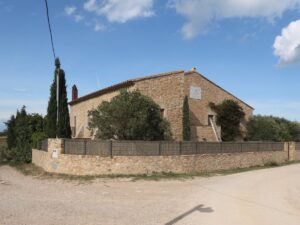
Mas Peraquintana
42.1369760000, 3.1005050000
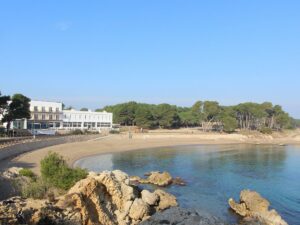
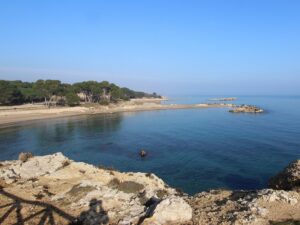
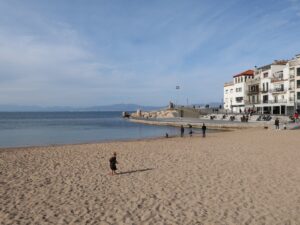
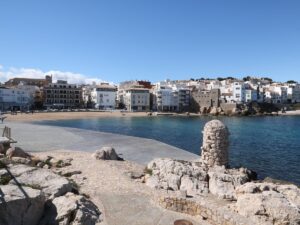
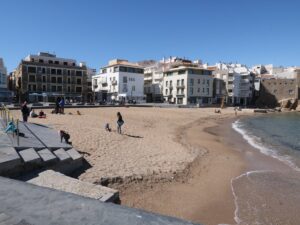
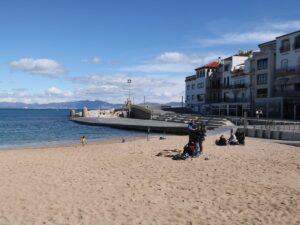
L’Escala is the only town in the Costa Brava whose sea promenade does not run along just one long beach, like, for instance, in Blanes or lloret de Mar. Instead, the beaches of L’Escala are a collection of coves and bays, from tiny to fairly large—Platja del Portitxol, Platja de Riells, Port d’en Perris, and Platja de les Barques (“The beach of the boats”).
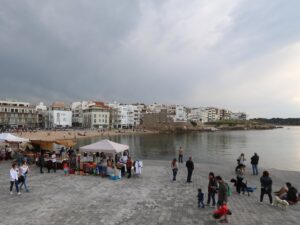
The latter, despite its small size (100 m long and 20 m wide), is considered the main beach of L’Escala. When offering to meet “on the beach” for a stroll, lunch, some ice cream or a glass of wine, the locals mean the beach of Platja de les Barques.
This is where the key town events take place, including the procession for the holy patron of seamen on July 16 (Festa de la Mare de Déu del Carme), the Festival of Anchovies and Salt (Festa de la Sal), and the performances of the PortalBlau festival.
The Platja de les Barques beach, being the main one in a popular resort town, is well equipped (there are showers, washrooms, summer lifeguard service) and holds the Blue Flag designation for the quality and safety of its water.
Platja de les Barques
42.1266000000, 3.1332140000